This post is technical. Well, kinda.
I suppose it cannot really since it entails a story about two unfortunate cookies and some random scientific banter. How could that be technical?
Well, it’s all about your point of view.
This post is about two cookies and a very understandable mishap that recently occurred in my parents kitchen.
Before I begin, let me just say that I doubt anyone really meant it to happen. And I’m kinda glad my parents weren’t around at the time or the story would likely be remembered somewhat less pleasantly.
Looking back, I rather found the whole excitement created by the event rather interesting and well, another reminder of nature shouting out at us to observe and take note.
And no domestic blame should be put on anyone. Haven’t we all burned an otherwise perfect food item in a microwave and lived to tell the tale?
It was a happy accident.
But two cookies, home-made with love and otherwise perfectly enjoyable, were destroyed forever.
I digress. So here’s what happened.
Unbeknownst to me on a regular kinda evening, my nephew in all innocence went to warm up a couple of recently-made sugar cookies in the microwave. I suppose we can all agree that was a perfectly reasonable thing to do. I mean, what could happen apart from the cookies melting down or boiling or turning into a cookie stew, worst case caking the glass stage in a kind of primordial cookie glue? Not sure anyone would eat that glue goo, but would we lose sleep over it? No, the world could do without a couple more cookies anyways, right? (I should defend the cookies here though and say they were some of the tastiest my nephew has recently cooked up. Much could be said about said cookies in fact, but again I digress).
Suffice it to say, I arrived in the kitchen smelling something burning. Once the initial excitement and confusion was relieved by the knowledge that the microwave was the source of the smell – and an intense cookie smoke the likes of which I don’t think I have ever seen before – we were able, in a collected and cool manner I may add, to move the burning cookies to the outside world, ventilate the kitchen – the microwave fuming with a cookie-tragic airs – and ponder the amusing spectacle.
The cookies in fact, were fused. Not only fused together, but fused at the exact center, like two UFO’s who collided in a synchronized vertical take-off disaster. Quite curious. I hope the photo below gives you an idea, the cookies later pulled from the garbage for photo record, with one part pulled off during the our bemused investigation.
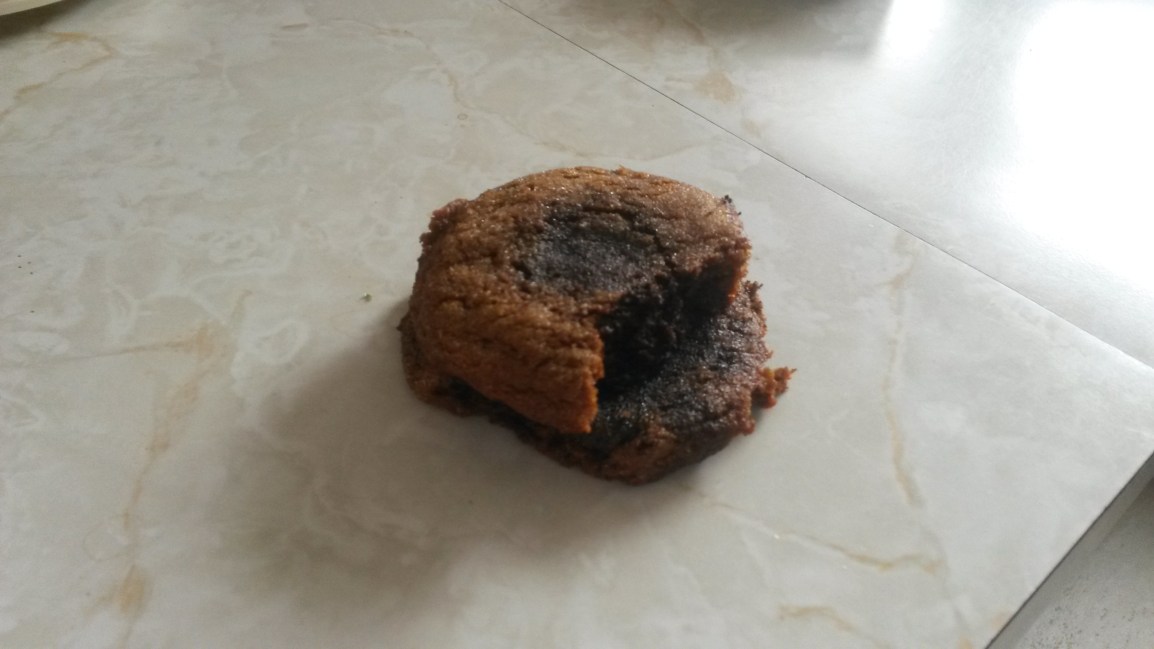
Now, you may not find the photo (or this story) all that interesting, but I do (and did) find it peculiar that the cookies were – and still remain so in the trash – fused together, and right in the center too. “How about that!”, I wondered.
It’s kind of odd, don’t you think?
I mean, let’s not argue the chemistry here. The experiment (and I prefer to call it an experiment than, say, ‘the cookie incident’) certainly proves that a microwave can burn cookies (and burn them together for that matter). And though that’s already curious (cause I might have expected a goo or boiling hot cookie bullet) it’s not the part that interested me at the time. Rather, isn’t it the fact that it fused the cookies right in the middle rather than completely fused together?
And now for the technical part (and the caveat that now you can stop reading my blog cause anyways I don’t know why anyone would want to anyways and it just seems like I’m writing this for no reason which I am)…
It seemed clear to me, that the only way for this to happen, was if the cookies (stacked one on top of one another) had been placed almost dead center of the turn-table, such that they only turned around and around themselves, with the center never really moving, rather than being off-axis.
Cause here’s the thing: you can actually confirm the speed of light using a microwave and a piece of food, let’s say a cookie.
I had read about this not long ago on some random internet page. The experiment consists of taking some food and disabling the rotating turn-table and zapping the food for a short amount of time. Then, measuring the distance between adjacent hot-spots in the food (the wavelength), and knowing the microwave frequency (probably written on the back of the microwave somewhere), one can calculate the speed of light.
Ah, right, and you should know that the microwave produces a standing wave inside the cavity. That means that hot-spots of cookie-cookie power don’t move around. And hence, why there’s a turn-table designed to do so instead!
Ok, so all that is pretty academic, but there I was with the fused cookies.
It was odd that they were fused only at the center… therefore, the only assumption I could make (assuming the turn-table hadn’t been blocked) was that the cookies had been placed exactly in the center!
Nature again had reared its physics-head to make us contemplate her beauty. And two cookies had just been sacrificed for that cause! A happy accident fortunately.
There I was, left thinking a little more about microwaves and musing over a method for cookie-welding or cookie-soldering. Isn’t that just fantastic?!
Thing was, the more I thought about it, the more I realized it’s not a simple as considering the standing-waves of micro-power inside the oven, is it?
Wouldn’t any food in the middle fuse before the rest even with the rotating plate spinning around, assuming at least some part of a cookie were covering the center of the turn-table?
Shouldn’t the microwave designers require that the exact center of the turn-table not correspond to a local hot-spot of the standing microwave? Wouldn’t that lead to cookie-fusing potential regardless of the rotation?!
Fused pancakes anyone?
Hmm… actually, the center must not be the location of a microwave hot-spot. Maybe if I had a cookie of just the right diameter I could create a cookie fused around the circumference?
I think some more experimentation is in order. “Hey nephew! Can you make me a cookies of all different sizes? But they gotta be nicely circular!”

 The Particle Physics Card Game
Published by