Introduction
If you’re reading this, you have a deck of The Particle Physics Card Game in your possession (or a friend does) and you are eager to try this one out.
Before you dive in, a bit of banter to remember.
This is a simple card game for all to enjoy. Above all, it is meant to be fun. You may learn something about particle physics along the way, but this is certainly not necessary to enjoy the game.
Those familiar with card games should find the concepts of game-play pretty straight-forward. Just think old-school Rummy meets Magic the Gathering, or something like that!
Bottom line is, I’m sure anyone can quickly learn the rules of this game and start playing!
Remember, you don’t need to be a particle physicist to play or enjoy the game! You just need a deck of our cards, some understanding of the rules, and an imagination.
And though this game is intended to be also educational, it is mostly intended to be fun.
Oh and by the way, I’m still working out myself the best rules and game-play options to make this game as fun as possible. I encourage anyone who has a deck to try it in whatever way they feel makes the game the best for the audience at hand. Imagine Grandmother playing with her grandchildren who have never played. Keep it simple and only use the quarks! 😉
Presently, I’m working on various game-play adaptations that can help ease new players into the game, at all ages, and to update this page with a better description of the game-play. Please look to updates on this page for more information as I figure it out for myself, family, and friends!
Let this page be a description of all the ‘cards’ out there in the game, and some information about how they work. If you’d like to skip the preamble, jump down a notch where the cards are described… for those sceptics out there, let me say my 10-year-old niece loves this game. Before I printed my first design, my niece and I played this game on Jiffy marked-up cards and had a blast! She is pretty clever for 10, but I didn’t expect her to know ‘why’ quarks need be combined such that their ‘color’ is white!! That’s just how you play. To be honest, I’m not even sure even the physics community really knows ‘why’ anything!
So, relax! Let go of what you think you know about science… the fact is, the concepts of this game are easy to learn, even for children, but that’s not the point. I designed it to be fun, and simple, while borrowing some ideas from our natural world.
With that said, let’s move on to the basics rules that everyone needs to start playing!
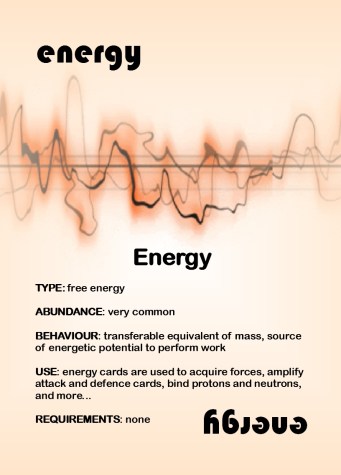
Energy
Perhaps the most fluid and pervasive substance of our known Universe: energy.
Energy exists in this game too. In abundance. In fact, it’s the most common card in the deck.
We will get to a description of how energy cards are actually used later…
But for now, and since we are going to be talking about it soon, here’s what an energy card looks like.
The fundamental forces
I felt it was fundamental to have the four forces of physics in this game, just like in our present description of the natural world.
Applying it to game-play, and to be used as an advanced concept once the players are expert in the basic mechanics, we introduce the concept that you must have certain forces in your universe in order to do certain things. Note that for new players to the game, I’ve found this a limitation that you might want to omit (put the force cards aside when you deal and explain the rules) for getting people used to quark mechanics (see above).
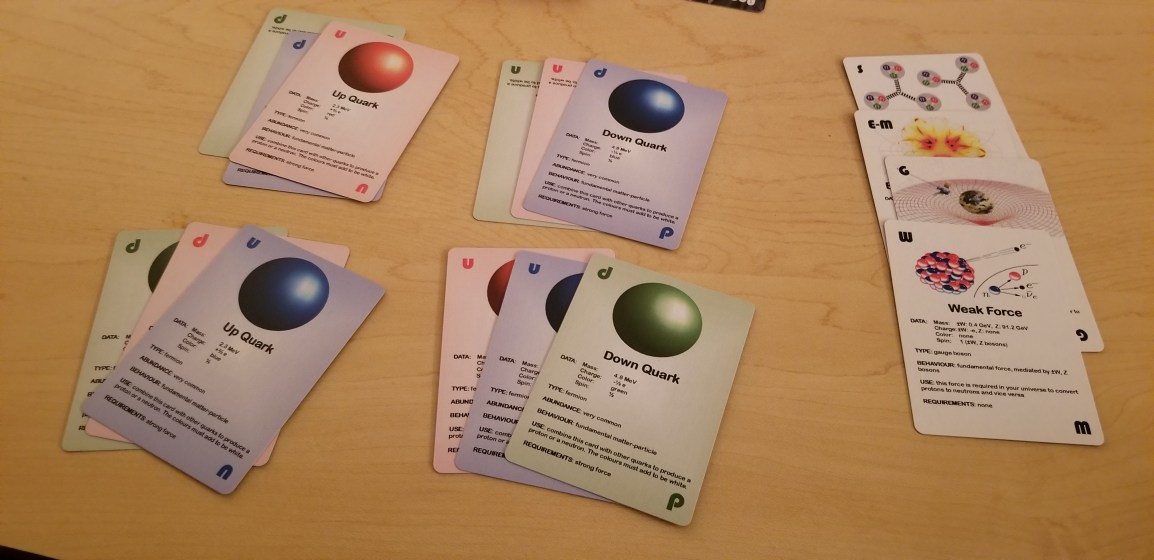
In the deck, there are four fundamental force cards, for up to 4 people each (not counting the Higgs!). Their cards are shown below:


In one original version of game-play, I proposed that you have to “purchase” the force cards that you don’t already have using two Energy cards. A newly acquired force card is placed face-up on the play surface in front of you, in your universe. Once played, the player can continue their turn. Energy cards when used are desposed of in the ‘used-up discard pile’.
I’ve since decided that in learning this game, it’s best to just put the force cards aside for a little while. In that sprit, and for the best game-play for new users, you can forget about the force restrictions and just make things fun and simple. More about that here [BEGINNERGamePlay]
Do you now possess a force card? Be proud! Now have the power to do things the force is required for!
Please note that in any level of game-play that you might choose, having more than one of each force card in your universe is not necessary. Forces are unique to other cards in that way. This is why there are exactly 4 of each force (shown above) for up to 4 players, 16 cards in total.
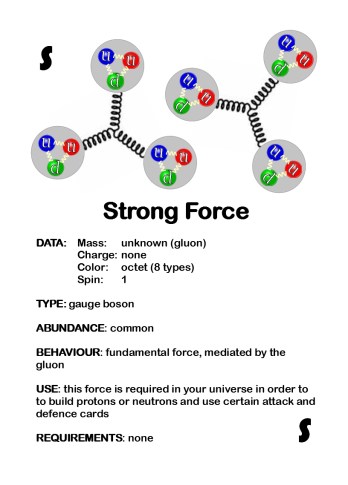
Now let’s discuss more about our Strong Force, which allows us to build matter in our Universe.
The Strong Force
The Strong Force is arguably the most basic force in this game, and it’s important to learn about first, before the others. This is because it is fundamental to building matter, a concept which also forms the basis for this game and its play.
I fact, it’s fun to just play with the Strong Force if you are playing with beginners or younger folks… it helps them learn the mechanics of the most fundamental part of this game which we shall describe shortly.
Here is the Strong Force card.
Of quarks, protons, and neutrons
The most fundamental concept in this game is, that in order to win players must build matter containing quarks. They do this by building protons and neutrons.
Well that sounds easy enough, but how do you do that? Good question and its quite simple!
The rules for building protons and neutrons are as follows:
- A proton is any combination of 2 up quarks and 1 down quark (u-u-d, d-u-u, u-d-u)
- A neutron is any combination of 1 up quark and 2 down quark (u-d-d, d-d-u, d-u-d)
- The color of the quarks must add to be white (red-green-blue, red-blue-green…)
In the list above, rules 1 and 2 are just mechanics. The 3rd rule is the catch… you must combine the quarks with three separate colors! For those who like particle physics, this is called Color Confinement. For those who like Rummy, this is just like creating a ‘set’.
It may sound complicated but it’s a simple idea. To make it clear, in the sections below, we illustrate with cards placed on the table in front of the player.
Keep in mind that the way you lay down the cards to build the colors of protons or neutrons doesn’t matter. Think Rummy where you can make runs or 3-of-a-kind sets without worrying about the order it appears on the table. In other words, the order isn’t important for you to combine the quarks, as long as you use one of each color: red, green, and blue. Easy 3rd rule, and similar to the analogy in physics using light, these three colors add up to make white!
But… wait!! You are not allowed to build either combination of all up quarks or all down quarks (UUU or DDD). Rules 2 and 3 state that only a UUD (proton) or a DDU (neutron) are fair game.
Let’s looks at some examples next.
Protons
A proton can be built when the player has 2 up quarks and 1 down quark which are three different colors… and… they possess the Strong Force in their universe. No energy is required.
“Good job! You have matter in your Universe!”
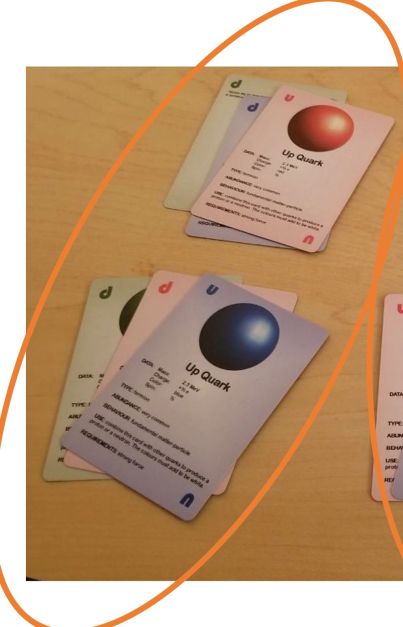
In the image below are two examples of protons that a player has created in their universe (laid on the table like in Rummy). These are not the only possible combinations for protons but you can see how each set has the three colors, red, green, and blue, and each is 2 up quarks and 1 down. (u-u-d, all 3 colors.)
How exactly a player executes their turn to build a matter (and continues if possible) is going to be described later on the page (or jump ahead to the Game Play section below).

Neutrons
A neutron can be built when the player has 2 down quarks and 1 up quark which are three different colors… and… they possess the Strong Force in their universe. (No energy is required.)
In the image below, from a first-player perspective, 2 neutrons are now in the player’s universe. (d-d-u, all 3 colors.)
Forge Helium to win!
So how do you win the game? Simple!
In the most basic game, you need to have built 2 protons and 2 neutrons using the Strong Force (see below) and then you need enough energy… and if you can play the energy cards once you’ve built the matter in your universe during your turn… you win!
For the scientists out there, the concept of winning in this game can be thought of as creating a nucleus of Helium, the second most abundant element in our physical universe!!
In the simplest version of the game, all you need to win is to have 2 protons and 2 neutrons in your universe, 2 energy cards that you can play in your turn… and you can fuse Helium. Congratulations! You are the first in the multi-verse to create such this element.
For a slighty longer game, you need 3 energy cards to create Helium. Another option includes deciding that you win by forging any element from the periodic table… try Lithium for a longer game, In honestly, I like the shortest game version going for Helium (2 protons and 2 neutrons) with 3 energy cards. I’d suggest staying away from Iron or Uranium for now.
Below you’ll see a picture from a first-person perspective of a player who’s ready to forge Helium and win the game. Note that the player also has the four forces in their universe (even though only the Strong Force is required to create the protons and neutrons).
Now that you have an overview of how the quarks combine from the section above, it’s time to discover the other force cards besides the Strong Force.
The E-M force
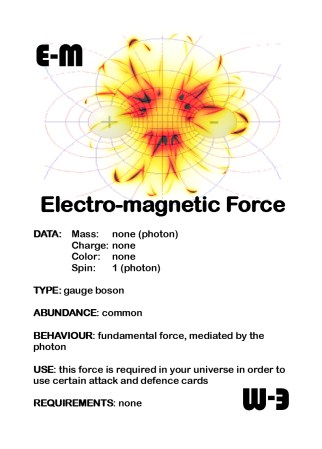
The E-M force allows the following cards to be played, during ones turn:
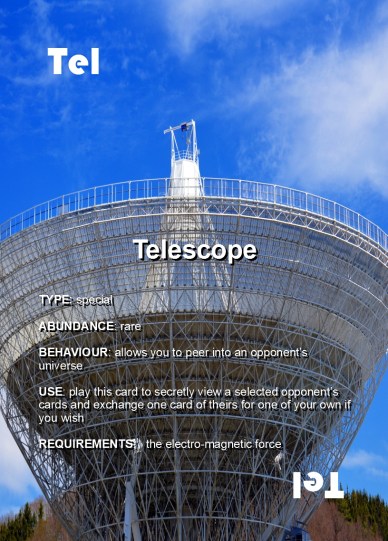
TEL – Telescope (no other force requirement. The Telescope can be played anytime the player has the E-M force in their universe.)
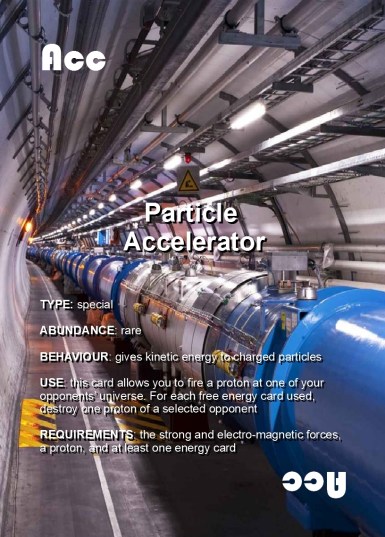
ACC – Particle Accelerator (this attack card also requires the Strong Force and a proton to be played during the turn. See details below about each card in the deck and its abilities)
The Gravitational Force
Clearly there is a Gravitational Force in this game.
After all, where would we all be, if it weren’t for our feet beneath us? That which gives us purpose and stride in life? That which binds us and bounds us to this precious piece of land that we all hold dear? Oh, Planet Earth, if it weren’t for you, and the force which holds us ever in lock step, could we even be human? To not walk this Earth is but a concept of dreams… can’t everyone creature on this great sphere appreciate the force that holds us to her?
Needless to say, the force of Gravity is a big part of this game. How could it have not been if you are not an astronaut or cosmonaut?
Here, therefore, is the Gravitational Force card, to be executed in certain special plays in this card game. Next to the Strong Force card, the G-force is a good choice to have.
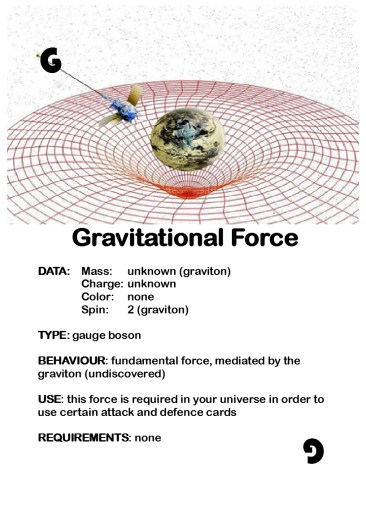
In version 1 of this game, there are few cards that the Gravitational Force allows you to use.
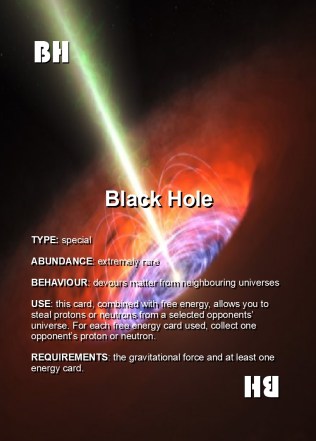
Black Hole
The Black Hole is a powerful attack card. It requires the Gravitational Force and at least one Energy Card to be used.
The Black Hole is played during the player’s turn and will gobble up (steal) an opponent’s protons or neutrons. It requires one energy card to be played in tandem with it and can be played with more than one energy card. For each energy card played along with this card, absorb one opponent’s proton or neutron. (Example, if the BH card is played with 2 energy cards, either 2 protons, 2 neutrons, or one of each can be stolen from an opponent and put in the player’s universe.)
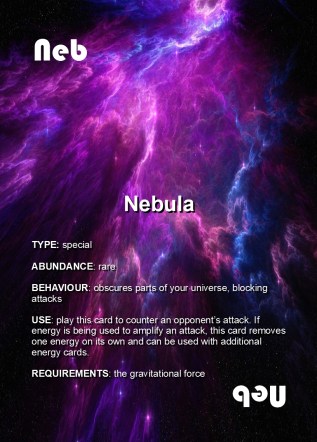
Nebula
The Nebula is a defense card. It requires the Gravitational Force to be used in play.
On its own, the Nebula card can be played if an opponent plays an attack card. Without additional energy cards it counts as one defense by itself. It can also be used with additional energy cards to boost its defense against attackers.
The Weak Force
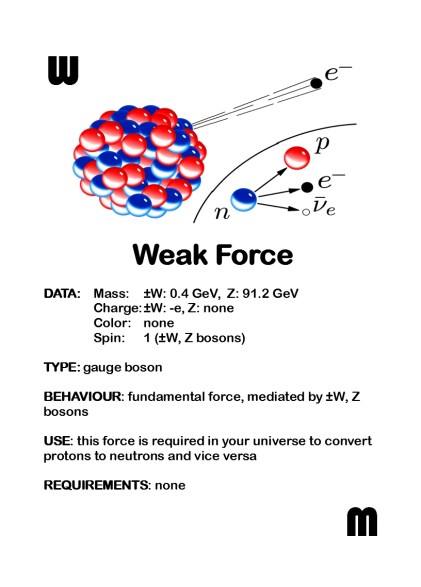
I introduced this force later in the development of the game. It’s an interesting one… a bit similar to how in card games you can swap out the joker, or the equivalent cards, with opponent’s cards.
The Weak Force is a gentle power, but can be used to annoy an opponents, and in certain cases, extend one’s turn and provide more options. Regardless, it’s a force of nature… and so the Weak Force deserves its rightful place in this game.
Once you have the Weak Force in your universe, you are allowed to swap out similar colored quark from your hand with one in your own matter or that of an opponents. This can be handy in that you can convert a proton to a neutron, or vice versa. This can help you, if you have 3 protons and only 1 neutron; changing a proton to a neutron brings you closer to winning the game by fusing Helium. Conversely, if an opponent is close to winning, you can rearrange their matter (move protons to neutrons) to stall them a turn or two.
Here’s its force card:
Higgs Boson
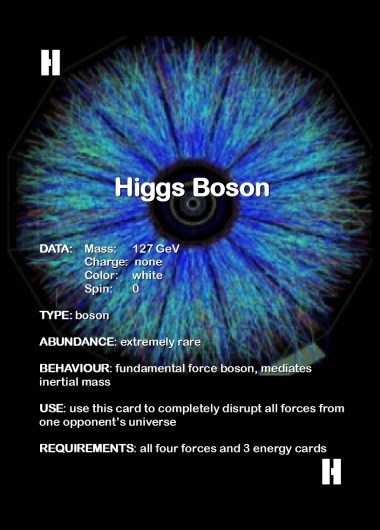
Where would a good particle physics card game be without the Higgs?!
Well, this game has one… and it’s a rare yet powerful one.
This card requires that the player have all 4 forces in their Universe to be played. Not an easy task…
In addition to all 4 forces, the player also requires 3 energy cards in their hand to play the Higgs Boson card. Defense cards are useless against the Higgs.
Once played, the Higgs destroys all in its path.
In the simplest version of this game, the player who can play the Higgs wins all. It is the ultimate ‘destroy all’ or ‘I win the game’ card.
An additional version to extend game play is that when this card is played, only a selected opponent’s universe is destroyed… all their force cards are forfeit, therefore all matter in their universe cannot exist. Force cards are returned to the bank and matter cards the used pile. The unfortunate opponent’s hand remains intact.
‘
 The Particle Physics Card Game